LATVIA

Government of Latvia
Latvia is a parliamentary republic. In May 2026, the Saeima approved a new centre-right government led by Prime Minister Andris Kulbergs of the United List. The four-party coalition consists of the United List, New Unity, the National Alliance, and the Union of Greens and Farmers. It replaced the government of Evika Siliņa and is expected to govern until the parliamentary election scheduled for October 2026.
The change of government is very recent. The new cabinet has not yet set out a separate alcohol-policy programme. Latvia's present alcohol framework therefore continues to be shaped mainly by reforms prepared under the previous government, adopted by the Saeima in January 2025, and implemented from 1 August 2025.
Sources: Cabinet of Ministers, Reuters
Current situation
Latvia combines a licensed private retail system with national rules on age, sales hours, marketing, online delivery, packaging, and permitted sales locations. It does not have a state retail monopoly. The minimum age for buying alcohol is 18. People aged 18 to 25 must show identification whenever they buy alcohol, whether or not the seller asks.
Alcohol remains a major public-health concern. Latvia recorded 11.3 litres of pure alcohol per person aged 15 and older in 2024, compared with 9.8 litres in 2010. Consumption reached 12.2 litres in 2021 and has since declined for three consecutive years, but Latvia remains among the highest-consuming OECD countries.
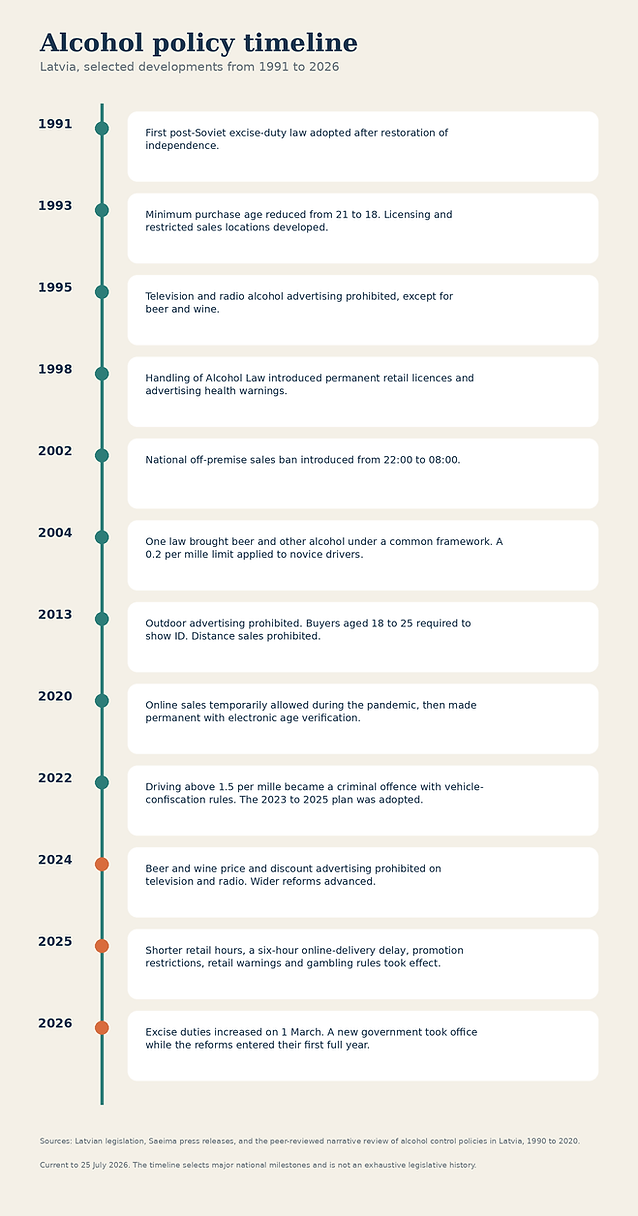
The most important recent policy change is the package that took effect on 1 August 2025. It shortened off-premise sales hours, introduced a six-hour waiting period for online orders, prohibited several forms of price promotion, required visible health and age warnings at retail outlets, and separated alcohol consumption from active gambling. These are now current rules, not proposals.
Alcohol consumption
OECD data show a long increase from 9.8 litres of pure alcohol per person aged 15 and older in 2010 to a peak of 12.2 litres in 2021. Consumption then decreased to 11.9 litres in 2022, 11.7 litres in 2023, and 11.3 litres in 2024.
The latest direction is encouraging, but it should be interpreted cautiously. The 2024 decrease preceded the August 2025 availability and marketing reforms, so it cannot be attributed to those measures. Latvia's Centre for Disease Prevention and Control has published a 2026 update covering registered consumption through 2025 and recalculated the 2022 to 2024 values after a population-method revision. Continued monitoring is therefore important.
Spirits account for an unusually large part of Latvian consumption. A 2024 policy brief based on a Ministry of Health commissioned study estimated that spirits represented about 40 percent of recorded consumption. This is relevant because Latvia's high total consumption is linked not only to frequency of drinking but also to a beverage mix with a substantial share of strong alcohol.
Sources: OECD Health Statistics, OECD Health at a Glance 2025, Latvia Centre for Disease Prevention and Control, FREE Network policy brief

Health and social burden
Latvia continues to have a high level of preventable mortality. The OECD Latvia Country Health Profile 2025 identifies alcohol and tobacco as the two major behavioural risk factors contributing to the country's high preventable mortality. Alcohol-related conditions are among the important causes of avoidable death.
A detailed Latvian cost study estimated that the direct and indirect costs connected with alcohol use in 2021 amounted to 1.3 to 1.8 percent of gross domestic product. The same study estimated a loss of almost 90,000 years of healthy and good-quality life. Direct costs included healthcare, policing, courts, prisons, social assistance, education, and prevention. Indirect costs included premature mortality and reduced productivity.
These estimates give the policy debate a broader frame. Alcohol policy in Latvia is not only a question of individual health or public order. It also concerns labour supply, public budgets, family wellbeing, and the sustainability of health and social services.
Alcohol availability
Alcohol retail is licensed by the State Revenue Service. Off-premise sales are permitted:
-
Monday to Saturday from 10:00 to 20:00
-
Sunday from 10:00 to 18:00
The hours do not apply in the same way to licensed premises that sell draught alcohol only for consumption on site, or to duty-free shops.
Online and app-based alcohol sales are legal through licensed retailers. The buyer's identity and age must be verified electronically before purchase and again at delivery. Since 1 August 2025, an order may not be delivered or collected until at least six hours after it was placed, and delivery must remain within the permitted retail hours.
Retail sales are prohibited in a number of settings, including educational, medical, social-care, police, and military premises, vending machines, certain kiosks and small premises, and other locations defined by law. Alcohol may not be sold to anyone under 18. People aged 18 to 25 must show ID in every purchase.
The law also restricts large plastic packages for higher-strength beer and other beverages, subject to material and producer-site exceptions. In gambling venues, alcohol may not be sold or consumed at slot machines, card tables, roulette tables, or other gambling equipment.
Sources: Law on the Circulation of Alcoholic Beverages, Saeima summary of the 2025 amendments
Alcohol advertising
Latvia prohibits advertising of alcoholic beverages on television and radio, except that beer and wine advertising remains possible within legal content limits. Since the amendments adopted in September 2024, television and radio advertising for beer and wine may not advertise prices or discounts.
Outdoor alcohol advertising is prohibited. Alcohol advertising is also prohibited in educational and medical institutions, on public transport, and on the outer covers of books, magazines, newspapers, and supplements. Where alcohol advertising is permitted, it may not show people drinking, link alcohol with sport or driving, claim therapeutic or stimulating effects, present abstinence negatively, or imply social or sexual success. Required warning information must occupy at least 10 percent of the advertisement.
From 1 August 2025, advertising alcohol prices and discounts is prohibited in newspapers and magazines, printed promotional publications, cinemas, websites and online interfaces, post and email, and retail outlets, including online shops and mobile applications. Production sites and producers' premises have a limited exception.
The same reform prohibits:
-
multi-buy offers that reduce the price per unit
-
alcohol discounts through loyalty programmes
-
discounted bundles that connect alcohol with another alcoholic beverage, good, or service
-
offering alcohol free of charge, as a gift, or as compensation for another purchase or service
The result is a substantial restriction on price-based promotion, although Latvia still does not have the near-total alcohol advertising ban found in Lithuania.
Sources: Saeima on electronic-media advertising, Law on the Circulation of Alcoholic Beverages
Alcohol taxation
Latvia applies beverage-specific excise duties. The rates increased on 1 March 2026 and further increases are already scheduled for 2027 and 2028.
Current standard rates from 1 March 2026 are:

Qualifying independent small producers may receive a 50 percent reduced excise rate. The scheduled multi-year increases provide predictability, but the health effect depends on whether tax increases keep pace with income and inflation across beverage categories.
Drink-driving
The general blood-alcohol limit is 0.5 per mille. A lower limit of 0.2 per mille applies to drivers with less than two years of experience and to several professional passenger-transport categories.
Since 25 November 2022, driving with a blood-alcohol concentration above 1.5 per mille is a criminal offence. Penalties can include imprisonment, temporary deprivation of liberty, probation, community service or a fine, together with loss of the driving licence for five years. The offender's vehicle is subject to confiscation. If the vehicle belongs to another person, the offender may be required to pay its full or partial value. Refusal to undergo the required medical test is also covered by the confiscation rules.
Recent developments and debate
The 2025 reform moved from proposal to implementation
The previous report described the sales-hour, online-delivery, promotion, warning, and gambling provisions as planned measures undergoing EU review. That is no longer accurate. The Saeima adopted the final amendments on 9 January 2025. The central restrictions took effect on 1 August 2025.
The final law requires point-of-sale warnings. It does not introduce the broad mandatory product-level nutrition and health labelling described in the earlier draft. That proposal attracted objections during the EU notification process and should not be presented as current Latvian law.
Early market reactions are not yet an evaluation
Public reporting in late 2025 showed mixed retailer experiences. Some businesses reported larger planned purchases before closing time, while others reported falling volumes in some beverage categories. Politicians indicated that the rules would be reviewed. These observations are useful for enforcement and evaluation design, but they are not evidence that the policy has succeeded or failed. The law had been in force for only a few months, and changes in turnover do not directly measure consumption or harm.
Source: Latvian Public Media
Excise duties are on a scheduled upward path
The March 2026 excise increase is part of a schedule extending through 2028. This creates a clearer medium-term tax path than the earlier period of Baltic cross-border tax competition. Monitoring affordability remains important because a nominal tax increase can lose preventive effect if incomes and retail prices rise more quickly.
A new government and an election year
The Kulbergs government took office in May 2026, only a few months before the scheduled parliamentary election. No new alcohol package has yet replaced the 2025 reform agenda. The most relevant near-term questions are implementation, enforcement, evaluation, and whether the next government will maintain or expand the current restrictions.
Alcohol policy timeline