


Finland

Government of Finland
Finland is governed by Prime Minister Petteri Orpo's four-party coalition, formed in June 2023 by the National Coalition Party, the Finns Party, the Swedish People's Party of Finland and the Christian Democrats. The government has 19 ministers. Following a cabinet reshuffle in June 2026, Karoliina Partanen became Minister of Social Security, whose portfolio includes alcohol and substance-use policy. Finnish Government: Orpo Government | Minister of Social Security
Alcohol policy under the Orpo Government has moved in a more market-oriented direction. The government programme promised to continue the 2018 Alcohol Act reform, increase competition, clarify cross-border sales and expand opportunities for domestic producers. This direction has produced two major enacted changes: the retail strength limit was raised for fermented beverages in June 2024, and a broader reform covering delivery, distance sales, Alko opening days and online marketing entered into force in July 2026. At the same time, Finland retains high alcohol taxes, licensing controls, restricted sales hours and Alko's exclusive retail role for beverages above the limits applying to ordinary shops.
The political debate remains divided. Government parties have presented the reforms as responsible deregulation and support for consumer choice and entrepreneurship. THL, public-health organisations and parts of the opposition have stressed that greater availability can increase consumption and harm, especially among people already at risk. Parliament required the effects of the 2026 reform to be monitored and reported.
Current alcohol policy framework
The Ministry of Social Affairs and Health leads national alcohol policy. Since January 2026, the Finnish Supervisory Agency has been responsible for national licensing, guidance and supervision of production, wholesale, retail sale, serving and alcohol marketing. Wellbeing services counties organise preventive substance-use work and health and social services, while THL produces statistics, research and implementation support. Ministry of Social Affairs and Health: Alcohol policy
Finland continues to use a mixed system of monopoly retail, licensed private retail, taxation, age limits, restricted sales hours and marketing controls. Grocery shops, kiosks, petrol stations and other licensed outlets may sell fermented beverages containing up to 8.0% ABV and beverages produced by other methods containing up to 5.5% ABV. Products above these thresholds are generally sold through Alko, apart from limited production-site exceptions and licensed serving.
Recent policy developments
Retail limit raised in 2024
On 10 June 2024, licensed ordinary retailers gained the right to sell fermented beverages containing up to 8.0% ABV. The previous limit had been 5.5%. The change covers products such as stronger beer, cider and fermented wine, but it does not extend the 8% limit to spirit-based drinks. Those remain subject to the 5.5% limit outside Alko. Ministry of Social Affairs and Health
Delivery and distance-sales reform enacted in 2026
Parliament approved a further Alcohol Act reform on 23 June 2026, and the first provisions entered into force on 3 July. The law creates a new delivery-licence system, clarifies cross-border distance sales from EU and EEA countries, permits Alko stores to open on Sundays and public holidays, and allows restricted online marketing of strong alcoholic beverages by domestic producers. Finnish Supervisory Agency | Ministry of Social Affairs and Health
The delivery provisions are staggered and are not yet operational. Applications for delivery licences can begin on 3 November 2026. Licensed deliveries may start on 3 January 2027. Domestic grocery shops, kiosks, petrol stations and restaurants will be able to deliver only the products covered by their existing retail rights. Stronger beverages will be ordered from Alko. Deliveries and cross-border distance-sale handovers will be permitted only between 09:00 and 21:00. Operators need a delivery licence, delivery staff need a delivery pass, and licence holders must maintain a self-monitoring plan.
Alcohol may not be delivered to minors, heavily intoxicated people, schools, early-childhood education sites, health and addiction-service units, child-welfare residential units, public playgrounds, licensed serving areas, public events or areas where the police have prohibited drinking. Parliament also required official impact monitoring and a broad report within two years.
Alko opening days
The July 2026 reform allows Alko to open every day, including Sundays and public holidays, within the same 09:00-21:00 maximum applied to other alcohol retailers. Alko began Sunday opening in selected stores on 5 July 2026, generally from 12:00 to 18:00. Opening hours still vary by store. Alko
Small-producer sales remain before Parliament
In April 2026, the government submitted a separate bill to expand direct sales at production sites. It would replace the current farm-wine and craft-beer exceptions with one system covering domestic small breweries, wineries and distilleries, including products of all strengths. Eligible producers could manufacture up to 100,000 litres of pure alcohol annually, with direct sales above the ordinary retail limits capped at 25,000 litres of pure alcohol. These products could not be home-delivered by producers. As of 31 July 2026, Government Proposal HE 44/2026 remained under parliamentary consideration and had not entered into force. Ministry of Social Affairs and Health | Parliament: HE 44/2026
Wine sales study
The government commissioned a study on moving wines of up to 15% ABV outside Alko's exclusive system. Published in April 2025, the study considered three possible models: sales in grocery shops, takeaway sales from licensed restaurants, and specialist wine shops. It identified benefits for competition and convenience but also risks of higher consumption, harm and a weakened basis for the remaining monopoly. No corresponding government bill had been enacted by 31 July 2026, so wines above the ordinary retail limits remain within Alko's general exclusive retail system. Finnish Government study release
Alcohol consumption trends
Finland's long-term decline in alcohol consumption continued in the latest statistics. Recorded consumption was 6.9 litres of pure alcohol per person aged 15 and over in 2025, 4.5% lower than in 2024. The latest available estimate of total consumption is 8.3 litres in 2024, including 7.2 litres of recorded consumption and 1.1 litres of unrecorded consumption. Total consumption fell by 4.4% from 2023. THL: Alcohol consumption
THL cannot publish an official total-consumption estimate for 2025. The data-collection method for passenger imports and online purchases changed from telephone interviews to an internet panel, creating a break in comparability. Official total and unrecorded consumption will therefore be unavailable for 2025-2027. The consumption graph preserves the comparable total series through 2024 and adds the 2025 recorded figure separately.

Beer remains the largest category and represented almost half of recorded consumption. Retail purchases dominate the market: grocery shops and Alko accounted for 87% of recorded consumption in 2025. In 2024, on-premise consumption represented 11% of recorded consumption. The retail system in 2024 included 372 Alko stores, 115 Alko pickup points, 4,090 grocery, kiosk and petrol-station alcohol outlets and 10,041 serving licences. THL statistical report 2024
Drinking patterns and harms
The most recent broad population survey shows that alcohol use is unevenly distributed. In 2023, 48% of men and 22% of women drank alcohol at least weekly. Twelve per cent of adults were abstinent. Twenty-one per cent reported heavy episodic drinking of at least six standard drinks on one occasion at least monthly, while 28% exceeded the AUDIT risk threshold. THL: Drinking patterns among Finns
THL estimates that 76% of all alcohol consumed in 2023 was associated with risky drinking, either high average consumption or binge drinking. Twenty-four per cent of the population, nearly one million people, were at risk of long-term health problems or harm from binge drinking. In 2024, 1,594 people died from alcohol-related diseases and accidental alcohol poisoning, 7.6% fewer than in 2023. Alcohol nevertheless remains an important contributor to health inequalities and premature mortality. THL | Statistics Finland
Young people
Alcohol use among adolescents has continued to decline. In the 2025 School Health Promotion Study, nearly three quarters of pupils in grades 8 and 9 reported that they did not drink alcohol at all. Abstinence was less common among students in the first two years of general upper secondary and vocational education, where fewer than half reported no alcohol use. The direction is positive, but prevention policy continues to emphasise delaying initiation, preventing intoxication and limiting young people's exposure to alcohol marketing in digital environments. THL School Health Promotion Study 2025
Alcohol taxation
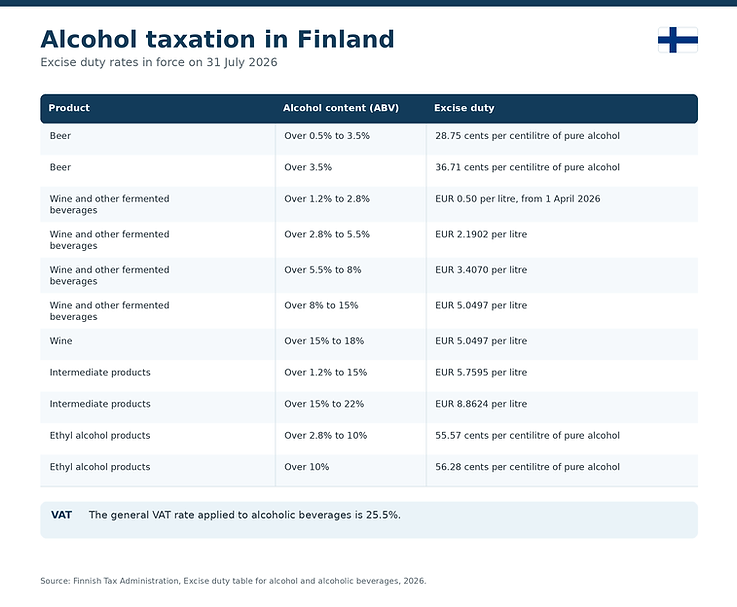
Finland levies excise duty according to beverage type, alcoholic strength and volume. The general VAT rate of 25.5% also applies to alcohol. The following excise rates apply in 2026. Finnish Tax Administration | VAT rates
.png)
The 2026 rates increased taxes across the main beverage categories. Compared with 2025, the duty on beer over 3.5% rose from 36.20 to 36.71 cents per centilitre of pure alcohol, wine of 8-15% from €4.56 to €5.0497 per litre, and ethyl alcohol over 10% from 55.50 to 56.28 cents per centilitre of pure alcohol.
Availability and age limits
Retail sales of beverages above 2.8% ABV require a licence and are permitted from 09:00 to 21:00. Beverages above 1.2% may not be sold to anyone under 18, and beverages above 22% may not be sold to anyone under 20. Retail sale to a visibly intoxicated person, or where there is reason to suspect onward supply to a minor or intoxicated person, is prohibited. Finnish Supervisory Agency
Licensed premises may generally serve beverages above 2.8% from 09:00 until 01:30. Customers may consume drinks for one hour after service ends. Extended service after 01:30 is possible through notification or permission, subject to supervision and local conditions. Finnish Supervisory Agency
Alcohol marketing
Marketing of beverages up to 22% ABV is permitted but tightly restricted. It may not target minors, portray intoxication positively, link alcohol to improved performance or social success, or use prohibited consumer-generated and sharing mechanisms. Television and radio advertising is restricted during daytime and evening hours, and alcohol advertising is generally prohibited in public places subject to limited exceptions.
The July 2026 amendment created a new exception to the former general ban on consumer marketing of strong alcoholic beverages. Domestic producers may now market strong products on their own websites and social-media accounts within statutory limits, including to audiences in Finland and other EEA countries. Strong-alcohol marketing remains prohibited on television, radio, in cinemas, printed newspapers and magazines, and in public places outside authorised retail and serving environments. The Finnish Supervisory Agency is updating its detailed guidance following the reform. Ministry of Social Affairs and Health
Prevention and treatment
The State sets legislation and taxation, while wellbeing services counties organise preventive substance-use work and health and social services. Municipalities, schools, workplaces and civil-society organisations also have important prevention roles. Finland's Action Plan for Preventive Substance Use Work 2026-2035 brings together national objectives for preventing harm from alcohol, drugs, tobacco and nicotine, and gambling. It contains 45 measures built around research-based leadership, preventive work in everyday environments, early identification and needs-based support. Protecting children and young people and reducing stigma are cross-cutting priorities. THL: Action Plan 2026-2035
Alcohol policy timeline
