

Norway

NORWAY

Political situation
Norway is governed by Prime Minister Jonas Gahr Støre and the Labour Party. The Centre Party left the coalition in February 2025, after which Labour continued alone as a minority government. In the parliamentary election of 8 September 2025, Labour remained the largest party and won 53 of the Storting's 169 seats. The five red-green parties together hold 88 seats, but Labour must negotiate with the Centre Party, Socialist Left Party, Red Party and Green Party to secure majorities. The Progress Party is now the largest opposition party with 47 seats. Norwegian Government | Storting: party representation 2025-2029
The government describes security, employment, health, local communities and economic stability as its main priorities for 2025-2029. Alcohol policy remains broadly restrictive and public-health oriented. The core instruments are high excise duties, the Vinmonopolet retail monopoly, licensing, age limits, restricted sales and serving hours, and a comprehensive advertising ban. However, the current political debate also includes pressure to provide more opportunities for small producers and tourism businesses. This is most visible in the government's 2026 proposal to expand direct producer sales while formally preserving Vinmonopolet.
Current alcohol policy framework
Norway has one of Europe's more restrictive alcohol policy systems. The Alcohol Act aims to limit social and individual harm and, as part of that purpose, to limit consumption. The Ministry of Health and Care Services is responsible for national policy and legislation. The Norwegian Directorate of Health administers national guidance and supervision, while municipalities issue most retail and serving licences, set local hours within national limits and conduct controls. Norwegian Government: alcohol policy
Vinmonopolet, a state-owned company under the Ministry of Health and Care Services, has the exclusive general right to retail wine, spirits and beer above 4.7% ABV. Licensed grocery shops may sell drinks up to 4.7% ABV. Kiosks and petrol stations cannot receive an alcohol retail licence. Restaurants and bars need municipal serving licences. Private online purchases and home delivery are permitted within the licensing and age-control system, including orders through Vinmonopolet.
Recent policy developments
Expanded producer sales proposed in 2026
On 5 June 2026, the government opened a consultation on a limited system allowing small producers to sell a broader range of alcoholic beverages directly to visitors. The proposal covers beverage groups 2 and 3, including strong beer, grape wine and spirits. Products would have to be fermented or distilled at the site, producers would have to be independent and below specified production ceilings, and sales would have to be connected to a paid visit with educational content. Ministry of Health and Care Services consultation
The proposed annual production limits are 200,000 litres for products up to 10% ABV, 100,000 litres for products from 10% to 22% ABV and 50,000 litres for products above 22% ABV. The proposed annual direct-sales caps are 15,000 litres for group 2 and 5,000 litres for group 3. The government's preferred per-visit limits are 1.5 litres of group 2 and 0.5 litres of group 3. The consultation remains open until 5 September 2026. These rules are therefore proposals, not current law.
Norway already permits limited sales of certain self-produced cider and fruit wine above 4.7% and up to 22% ABV when strict conditions are met. The current exception mainly concerns products outside the scope of the EEA Agreement. The 2026 proposal follows a Storting decision from December 2024 and an EEA legal assessment published in September 2025. EEA legal assessment
National alcohol strategy evaluated
Norway's National Alcohol Strategy was adopted for 2021-2025 and later extended to 2030. Its main quantitative goal is a 20% reduction in harmful alcohol use from the 2010 baseline. In June 2026, the Norwegian Institute of Public Health published a mid-term evaluation. Registered sales had fallen from 6.59 litres of pure alcohol per person aged 15 and over in 2010 to 5.98 litres in 2025, a reduction of about 9%. FHI concluded that the 20% target is unlikely to be reached if the main policy instruments remain unchanged. FHI evaluation
FHI found that implementation was uneven across the strategy's 42 measures. It recommended considering a combined strengthening of effective population-level measures, including higher duties, tighter traveller-import quotas, health warning labels and substantial restrictions on the number and opening hours of retail and serving outlets. These are evaluation recommendations, not adopted government policy.
Stronger enforcement of the advertising ban
Since 17 September 2024, the Norwegian Directorate of Health has been able to impose administrative fines for certain breaches of the Alcohol Act, including the advertising ban. In August 2025, it imposed a NOK 1.5 million fine on the music group Ballinciaga and a corresponding fine on the producer involved after extensive promotion of an alcoholic product on social media and at events. The case shows that the long-standing ban is being actively applied to influencer-style marketing, shared branding and digital promotion. Norwegian Directorate of Health
Youth drinking has moved upwards from historic lows
FHI reported in 2025 that alcohol use and intoxication among 15-16-year-olds increased between 2019 and 2024 after earlier reaching historically low levels. In 2024, 32% reported drinking in the previous 30 days, compared with 26% in 2019, and 47% had consumed alcohol during the previous year. Young people's perceived access to alcohol also increased, with peers, alcohol taken from home and alcohol supplied by parents among the reported sources. FHI report on young people
Alcohol consumption trends
Registered alcohol sales fell to 5.98 litres of pure alcohol per resident aged 15 and over in 2025, down from 6.16 litres in 2024 and 6.37 litres in 2023. The 2025 level is close to the pre-pandemic years and 9% below 2010. The pandemic peak was 7.44 litres in 2021, largely because travel restrictions shifted purchases from tax-free, cross-border and other foreign channels into recorded domestic sales. Statistics Norway: alcohol sales
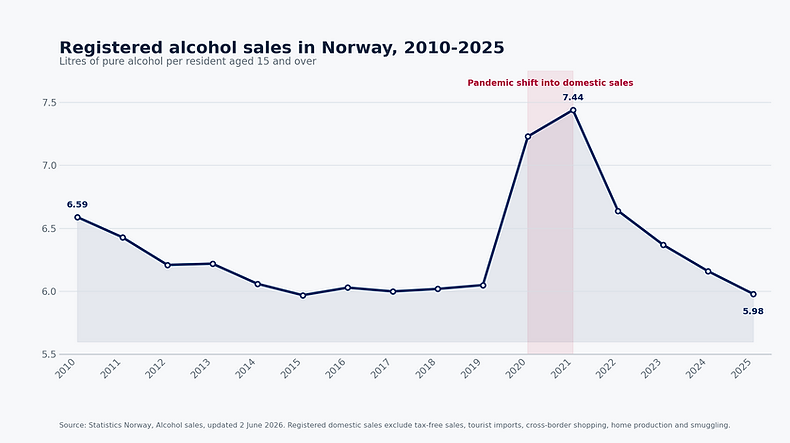
The series measures taxed domestic sales and does not include tax-free sales, tourist imports, cross-border shopping, home production or smuggling. It should therefore be described as registered sales, not total consumption. Survey data tell a somewhat different pandemic story: self-reported consumption among people aged 16-79 was broadly stable from 2012 to 2025, except for lower use during the pandemic years. FHI: use and sales of alcohol
In beverage-specific terms, the 2025 registered total consisted of 2.49 litres of pure alcohol from beer, 2.25 from wine, 0.95 from spirits and 0.28 from alcopops per person aged 15 and over. Vinmonopolet sold just over 90 million litres of beverages in 2025, 2.2% less than in 2024. Sales continued to shift away from red wine and spirits and towards white wine, sparkling wine, beer, cider and alcohol-free products. Vinmonopolet sales 2025
Drinking patterns and harms
Around nine in ten people aged over 16 reported drinking alcohol during the previous year in 2025, while seven in ten drank during the previous four weeks. About half reported consuming six or more alcohol units on at least one occasion during the previous year. Monthly heavy episodic drinking, defined by FHI as more than five units on the same day at least once a month, was reported by 18% of people aged 16-79 in 2025, down from 19% in 2024 but above the roughly 17% level seen during much of 2012-2022. FHI: high alcohol intake
Alcohol remains a major risk factor for death, disease and loss of healthy life years. It contributes to chronic disease, injuries, violence and harm to people other than the drinker. FHI reports that alcohol-related deaths fell by about 20% from 2008-2012 to 2015-2019, but increased again after that period. More than 80% of deaths in the narrow alcohol-specific indicator are linked to alcohol dependence, alcoholic liver disease and alcoholic cardiomyopathy. FHI: alcohol dependence indicator
Alcohol taxation
Norway levies excise duty on alcoholic beverages above 0.7% ABV. The rate depends on beverage type, strength and volume. Spirits-based beverages are taxed per percentage point of alcohol per litre. Fermented beverages above 4.7% and up to 22% are taxed on the same basis, while lower-strength beverages have fixed per-litre bands. Alcohol is also subject to the 25% standard VAT rate and beverage-packaging taxes. Norwegian Tax Administration
.png)
Independent breweries producing less than 500,000 litres annually may receive reduced rates for fermented beverages above 3.7% and up to 4.7% ABV. In 2026, the reduced bands range from NOK 19.36 per litre for the first 50,000 litres to NOK 23.00 for annual volume between 150,000 and 200,000 litres. The ordinary rate applies above the eligible reduced-rate bands.
Alcohol availability

Norway had 353 Vinmonopolet stores in August 2025. All products in the online range can be ordered for collection through the nationwide network, which is intended to provide geographically equal access while preserving monopoly control. Municipal availability has nevertheless increased over time. FHI's 2026 strategy evaluation notes growth in the number of sales and serving places and in the share of premises permitted to serve until the statutory maximum of 03:00.
Alcohol advertising
Norway has prohibited alcohol advertising since 1 July 1975. The ban covers beverages over 2.5% ABV and is interpreted broadly. It applies to print, broadcasting, outdoor advertising, websites, social media, product displays, samples and other mass communication intended to promote sales. It also restricts advertising of non-alcohol products using the same brand or distinguishing features as an alcoholic product and the use of alcoholic products in advertising for other goods or services. Norwegian Directorate of Health: section 9-2
Limited exceptions permit necessary, neutral information. Examples include genuinely independent editorial coverage, restrained product and price information at licensed online sales channels, signs identifying premises, and certain factual industry communications. The exceptions do not permit positive lifestyle claims or ordinary brand promotion. The Directorate of Health supervises the ban and may order correction, impose coercive fines and, since September 2024, issue administrative infringement fines.
Prevention and treatment
The national alcohol strategy combines population-level regulation with local prevention, early intervention, treatment, research and cooperation with schools, workplaces, sport and civil society. Municipalities are central because they control retail and serving licences and are responsible for local public-health work. Specialist health services and municipal health and social services provide treatment for alcohol-use disorders, while non-governmental organisations supply prevention, peer support, counselling and rehabilitation.
The 2026 evaluation found that municipal support measures had largely been maintained, but that many early-intervention measures only began moving forward in spring 2026 and research measures had not been followed up sufficiently. The main policy question for the remaining strategy period is therefore whether Norway will strengthen the most effective population-level measures while simultaneously considering greater commercial availability through producer sales.
