

5th NordAN drug network meeting, June 19, 2024
The 5th NordAN drug network meeting focused on prevention, harm reduction and recent drug policy developments. Oriol Esculies presented the Oviedo Declaration and its global prevention agenda, Cressida de Witte introduced WFAD’s work on harm reduction as part of a continuum of care, and Stig Erik Sørheim gave an update on recent Norwegian drug policy proposals.
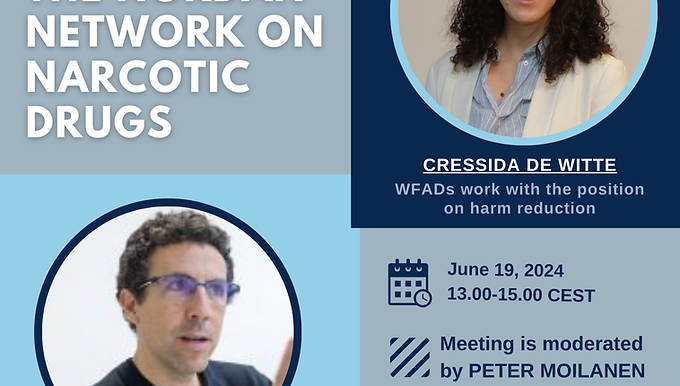
Online meeting
Programme
Oriol Esculies, International Relations, Association Proyecto Hombre, Spain
The Oviedo Declaration and the global prevention agenda
Cressida de Witte, WFAD
WFAD’s work with harm reduction as part of a continuum of care
Stig Erik Sørheim, Actis, Norway
Recent Norwegian drug policy proposals and their implications
Meeting summary
Oriol Esculies, International Relations, Association Proyecto Hombre (Spain)
Oriol Esculies's presentation on the Oviedo Declaration highlighted the global initiative on drug use prevention, emphasizing the coalition's efforts leading up to the next Commission on Narcotic Drugs (CND) in March. Launched at the last CND with input from international experts, the initiative aims to underscore the importance of incorporating effective, evidence-based drug use prevention in national and international drug policies. The Oviedo Declaration originated from a meeting in Oviedo, Spain, and has since been backed by a global task force comprising leaders and experts in the field.
The declaration has been translated into multiple languages to ensure accessibility and is particularly focused on influential countries to advocate for legislative changes and substantial incorporation of prevention measures in national budgets and drug policies. Colombia and Brazil are identified as key countries that will lead this initiative in the Americas, with expectations that their leadership could catalyze positive changes in neighbouring regions. The initiative is supported by the Spanish government and monitored by the Council of Europe and Spanish universities.
Esculies outlined specific examples of how the declaration is being promoted globally. In Bangladesh, for instance, local organizations and government drug coordinators have been engaged to support and integrate more prevention measures into national policies. In Colombia, regional directors are leveraging the initiative to enhance prevention efforts within their missions. Additionally, the initiative has been highlighted at various conferences, including a recent presentation to the Spanish Parliament.
The task force has proposed organizing virtual hearings on prevention, enabling focal points to present main challenges and generate official reports for distribution. These hearings have been scheduled for various regions, including the Americas, Asia Pacific, Africa, and Europe, with a forthcoming session for the MENA region. The initiative calls for increased investment in prevention, aligning with the World Drug Day slogan, "Invest in Prevention," and urges policymakers to recognize the importance of prevention across all age groups.
Esculies stressed the need to broaden the scope of prevention to encompass all drugs and related addictive behaviours, targeting all at-risk populations with tailored approaches. Prevention is framed as a right for minors, students, and youth, requiring well-planned strategies and integration into a continuum of care that includes treatment, recovery, and harm reduction. The presentation highlighted the necessity of prioritizing prevention in low and middle-income countries, where social and health infrastructures are often lacking.
Finally, the presentation underscored the importance of training more prevention professionals and incorporating this science into core educational curricula. There is also a pressing need for better monitoring data to evaluate the coverage, effectiveness, and relevance of prevention actions globally. The ten proposals of the Oviedo Declaration aim to incorporate prevention into drug policies effectively:
1. Dedicate at least 25% of the drug demand reduction strategy and policy budget to prevention by 2030.
2. Promote prevention targeting all ages, favouring earlier interventions.
3. Foster research and evaluation to avoid ineffective or counterproductive strategies.
4. Broaden prevention responses to focus on individuals and communities.
5. Mainstream intersectional approaches for all at-risk populations.
6. Boost multi-stakeholder prevention systems and document their effectiveness and cost-effectiveness.
7. Provide universal coverage in a continuum of care.
8. Prioritize action in low- and middle-income countries.
9. Empower current and future generations of prevention professionals.
10. Monitor prevention policies through accountable surveillance.
Through these measures, the Oviedo Declaration seeks to establish a comprehensive, evidence-based framework for global drug use prevention.
Takeaway points:
Global advocacy for prevention: Emphasizes the need for countries to allocate at least 25% of their drug demand reduction budget to evidence-based prevention by 2030.
International collaboration: Highlights the involvement of influential countries like Colombia and Brazil and the promotion of the declaration through virtual hearings and local advocacy.
Comprehensive prevention framework: Advocates for a continuum of care that includes prevention, treatment, recovery, and harm reduction, with a focus on empowering professionals and prioritizing low and middle-income countries.
Cresside de Witte, WFAD
The presentation discussed the mission and activities of WFAD, emphasizing their commitment to harm reduction as part of a continuum of care. WFAD, a global organization with 437 member organizations in 68 countries, works to strengthen prevention, harm reduction, treatment, and recovery services. Their approach is rooted in promoting human and democratic rights, aiming for a drug-free world that upholds peace, dignity, and justice, with a special focus on the needs of women and children.
WFAD's activities are divided into three main pillars. The first pillar involves capacity strengthening and experience exchange through webinars, training sessions, and forums aimed at addressing gaps identified by members. The second pillar focuses on development projects that range from raising awareness and prevention to providing treatment and reintegration services. Examples include the Sober Youth Healthy Communities project in Kinshasa and the Acting Through Art project in Georgia. These projects aim to support youth, prevent gang involvement, and offer therapeutic alternatives.
The third pillar is advocacy, where WFAD represents its members at various institutional levels, including the United Nations and the European Union. They engage in high-level meetings and contribute to international policy discussions. WFAD's advocacy efforts also include responding to calls from the Office of the United Nations High Commissioner for Human Rights, ensuring that their perspective on harm reduction is well-represented.
Harm reduction, as presented, aims to minimize the risks and harms associated with drug use. The concept, originating from public health responses to the AIDS epidemic, has evolved and sometimes been polarized in international debates. WFAD's approach integrates harm reduction into a broader continuum of care, viewing it as a bridge to treatment and recovery, not an end goal. They emphasize the need for harm reduction services to be comprehensive, incorporating healthcare and social support, and ensuring they are non-discriminatory, evidence-based, and culturally sensitive.
WFAD advocates for harm reduction measures that protect individuals from negative health and social consequences while promoting overall well-being. They stress that drug policies should ensure equal access to health services and uphold the dignity and security of people who use drugs. The presentation highlighted successful harm reduction practices, such as needle exchange programs and overdose prevention education, which include naloxone training, medical screenings, and peer recovery support.
The presentation concluded with a call for continued advocacy and the promotion of harm reduction as part of a comprehensive public health framework. WFAD aims to highlight best practices and encourage a balanced approach to drug policy, integrating prevention, treatment, recovery, law enforcement, research, and supply reduction. They plan to publish more statements and define a clear vision for harm reduction, emphasizing it as part of the continuum of care, rather than an isolated goal.
Takeaway points:
Harm reduction as part of continuum of care: Harm reduction should be viewed as a bridge to treatment and sustained recovery, rather than an end goal itself. It must integrate a wide range of healthcare and social support services, focusing on the overall well-being and social reintegration of individuals.
Comprehensive and inclusive drug policies: Drug policies should ensure equal access to health services and be non-discriminatory, evidence-based, and culturally sensitive. Harm reduction measures must protect individuals from negative health and social consequences while promoting overall health and dignity.
3. Global advocacy and best practices: WFAD is committed to promoting harm reduction through international collaboration and advocacy, highlighting successful practices like needle exchange programs and overdose prevention education. Their approach involves strengthening the capacities of member organizations and engaging in high-level policy discussions to ensure a balanced and effective response to drug use.
Stig Erik Sørheim, Actis (Norway)
Stig Erik Sørheim responded to a question regarding the recent proposals presented by the Norwegian investigation committee. The committee had introduced their recommendations the previous day, and Sørheim was asked to elaborate on their importance and implications. He began by providing context, explaining that the background to these proposals lay in changes to police practices following a drug policy reform discussion a few years ago. These changes had led to fewer police interventions in minor drug crimes, prompting the government to establish the commission to address emerging issues.
Stig Erik highlighted that the commission's proposal aims to reinstate some of the pre-2021 policies, granting the police more authority to investigate drug use and possession, including conducting searches and saliva tests. This shift is intended to clarify and enhance the enforceability of Norway's drug laws, which had become less effective due to recent limitations on police powers.
He also highlighted a significant challenge: defining addiction within the legal framework to determine when individuals should be exempt from punishment for drug possession. The commission's proposal suggests a contextual approach, considering various factors to address this issue. The proposal also involves reversing certain decisions made by the national prosecutor's office, aiming to bring clarity and enforceability to drug laws in Norway.
The discussion then turned to the proposal's political implications. Stig Erik emphasized the importance of achieving broad political agreement rather than making drug policy a contentious issue between major parties. He noted that while the proposal is likely to pass with the current government and populist party support, it risks being reversed if a new government takes office after the next election. Thus, a cross-party agreement would be more beneficial for long-term policy stability.
He also addressed the criticisms from drug legalization groups, who often portray the proposals as catastrophic. He argued for a pragmatic approach, focusing on resolving specific issues without turning the debate into a highly controversial political matter. This includes reinstating some police powers to ensure that drug laws are enforceable, as the current situation leaves police with limited capacity to act on drug use and possession.
A key part of the commission's proposal involves enhancing the effectiveness of local advisory units or drug dissuasion commissions. Stig Erik pointed out that these units currently lack sufficient impact, often requiring only a single meeting with individuals. The new proposal suggests multiple meetings to establish a relationship and motivate change, which is seen as a step in the right direction. Additionally, the introduction of voluntary urine screening was highlighted as a useful tool for individuals seeking to quit drug use.
In conclusion, Stig Erik expressed hope that the proposed reforms would broaden the available tools for addressing drug use, offering a more individualized approach. The commission's recommendations aim to create a more effective and comprehensive drug policy framework in Norway, addressing enforcement issues while supporting individuals in their recovery journeys. The ongoing political debate and potential for cross-party compromise will be crucial in determining the success and stability of these reforms.
Materials
Oriol Esculies´s presentation: https://www.nordicalcohol.org/_files/ugd/5ded79_21ed18ae1dec415c9ac6588b62786a1b.pdf