


FAROE ISLANDS
Government
The Faroe Islands are a self-governing part of the Kingdom of Denmark. Alcohol policy, taxation, retail regulation and public health are primarily administered by the Faroese authorities.
Beinir Johannesen became Prime Minister in April 2026. The government is a coalition of the People’s Party, the Union Party and the Social Democratic Party.
Alcohol policy
Alcohol policy in the Faroe Islands is considerably more restrictive than in Denmark and shares several features with the alcohol-control systems of Norway, Sweden, Finland and Iceland.
Its main elements are:
-
A public monopoly, Rúsdrekkasøla Landsins, commonly known as Rúsan, controls the import and retail sale of imported alcoholic beverages.
-
Domestic breweries may sell Faroese beer and cider through approved outlets.
-
The minimum age for purchasing and being served alcohol is 18.
-
Restaurants, bars and clubs need a licence to serve alcohol.
-
Commercial advertising that encourages the purchase of alcoholic beverages is prohibited.
-
Spirits sold in the Faroe Islands may contain no more than 60 percent alcohol by volume.
-
The blood alcohol concentration limit for driving is 0.2 per mille.
-
Alcohol is subject to product-specific excise duties.
-
Retail availability is limited through a small number of monopoly shops and restricted opening hours.
A national alcohol and drug policy presented in 2015 placed particular emphasis on restricted availability, price, prevention, protection of children and young people, treatment, monitoring and enforcement. The current public health recommendation is to drink as little as possible because no level of alcohol consumption is entirely without health risk.
The public health guidance uses the “10-4” rule for adults: no more than 10 Faroese standard drinks per week and no more than four on any one occasion. One Faroese standard drink contains approximately 12 grams of pure alcohol. People under 18 and women who are pregnant or trying to become pregnant are advised not to drink at all.
Recent developments
The future of the retail monopoly is periodically debated. In 2022, a bill proposed allowing alcoholic beverages of up to 22 percent alcohol by volume to be sold in ordinary grocery shops. The bill was rejected by 23 votes to one in the 33-member Løgting.
An informal online poll conducted around the same time, with almost 7,000 participants, found that 58 percent supported grocery-store sales of beer and wine, while 37 percent opposed them. The poll was not a representative population survey, but it illustrates the difference between public debate about convenience and the public health authorities’ support for restricted availability. PopNAD overview
No major liberalisation followed the 2022 vote. The monopoly, the 18-year age limit and the licensing system remain central features of Faroese alcohol policy.
Alcohol consumption trends
Recorded alcohol sales have been relatively stable since the early 1990s. Between 1993 and 2021, sales through Rúsan and Faroese breweries generally ranged from 6.2 to 7.1 litres of pure alcohol per inhabitant aged 15 or older.
In 2021, sales through Rúsan and Faroese breweries corresponded to 6.7 litres of pure alcohol per inhabitant aged 15 or older. Reported duty-free sales added the equivalent of 1.2 litres. Together, these sources recorded 7.9 litres per inhabitant aged 15 or older. However, this total is not an exact measure of consumption by Faroese residents because duty-free sales include purchases whose buyers’ place of residence is unknown.
Beer accounts for the largest share of recorded alcohol sales. Since the establishment of Rúsan, spirits sales have declined while wine sales have increased. This suggests a gradual movement away from the older pattern of infrequent but heavy spirits consumption towards more regular consumption of beer and wine.
The official statistical series has since been updated through 2025. Some duty-free sales cannot be allocated to Faroese residents because the buyer’s country of residence is not always recorded. Light beer is also excluded from the per-capita alcohol calculation. Recorded sales should therefore not be presented as an exact measure of consumption by Faroese residents.
More information: Statistics Faroe Islands

Drinking patterns and adult health
The 2023 Faroese population health survey provides a more detailed picture than retail sales alone. The survey was conducted among residents aged 18 to 85 and received 5,104 responses.
-
12.3 percent drank more than 10 standard drinks in a normal week.
-
The proportion was 20.9 percent among men and 5.9 percent among women.
-
Among people aged 18 to 24, 32.6 percent of men and 19.6 percent of women exceeded 10 drinks per week.
-
11 percent of men and 3 percent of women reported consuming at least five drinks on one occasion every week.
-
23.5 percent of men and 38.5 percent of women had not consumed alcohol during the previous 12 months.
-
Among people exceeding 10 drinks per week, 36 percent of women and 22 percent of men wanted to drink less.
These figures show a strongly unequal distribution of alcohol consumption. A substantial part of the population does not drink, while risky consumption is concentrated especially among men and younger adults.
The Health Authority estimates that alcohol may contribute directly or indirectly to approximately 25 to 30 deaths annually in the Faroe Islands. This is an extrapolation based on the Danish estimate that alcohol contributes to approximately 6 percent of all deaths, rather than a count derived from Faroese cause-of-death records. Source: Faroese Health Authority
Alcohol consumption among young people
The 2024 European School Survey Project on Alcohol and Other Drugs, ESPAD, found a marked decline in alcohol use among Faroese students aged 15 to 16.
-
64 percent had consumed alcohol at least once.
-
27 percent had consumed alcohol during the previous 30 days.
-
12 percent had been intoxicated during the previous 30 days.
-
28 percent reported heavy episodic drinking, defined as five or more drinks on one occasion, during the previous 30 days.
Lifetime alcohol use fell by 16 percentage points between 2019 and 2024. This was the largest decline recorded among the participating ESPAD countries.
Nevertheless, heavy episodic drinking remains relatively common among those who drink. The youth data therefore indicate both progress in delaying or preventing alcohol use and a continuing need to address intoxication-oriented drinking. Source: ESPAD Report 2024
Alcohol taxation
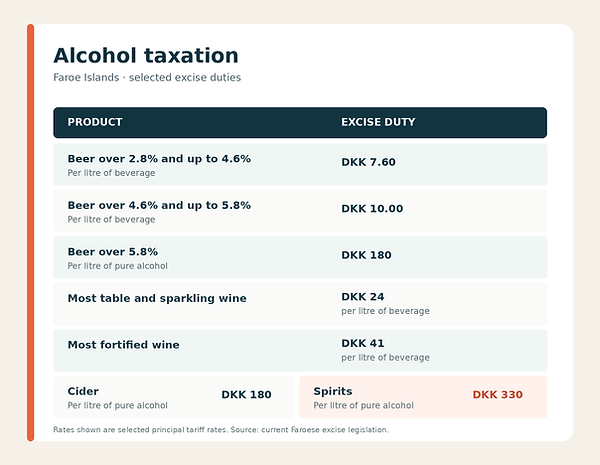
Alcohol is subject to Faroese excise duty, with rates differentiated by beverage type and strength. The main rates are presented in the accompanying taxation graphic. Stronger products generally carry a higher tax burden. Current Faroese excise legislation
Alcohol availability
Key points:
-
The minimum purchase and serving age is 18.
-
Rúsan has a monopoly on the import and retail sale of imported alcohol.
-
There are eight Rúsan outlets across the islands.
-
Opening hours are limited and differ between locations. The shops are closed on Sundays.
-
Domestic beer and cider may also be purchased from approved brewery or local beer outlets.
-
Duty-free alcohol is sold at the airport and on the international ferry.
-
Ordinary grocery shops cannot sell regular beer, wine or spirits.
-
Restaurants, bars and clubs require a serving licence.
-
A limited licence permits beer and wine, while a full licence permits all legally available alcoholic beverages.
-
Service to people under 18 is prohibited.
-
Spirits may not exceed 60 percent alcohol by volume.
-
Serving alcohol at festivals and other outdoor events has been permitted since 2007, subject to licensing.
-
The blood alcohol concentration limit for driving has been 0.2 per mille since 2009. Faroese Road Safety Council
Alcohol advertising
Key points:
-
Commercial advertising that encourages the sale or purchase of alcoholic beverages is prohibited.
-
A direct recommendation to purchase a particular alcoholic product is considered unlawful.
-
Journalism and factual reporting about new alcoholic products are not automatically classified as advertising.
-
Police and prosecutors make the initial assessment of whether content constitutes prohibited advertising. Courts make the final legal determination.
-
The distinction depends on the content and commercial purpose of the communication, not simply on whether alcohol is mentioned.
This distinction became the subject of public discussion in 2022, when the responsible minister explained that media may report on new alcohol products but may not publish a recommendation encouraging consumers to buy a particular product. Source: Kringvarp Føroya
Alcohol policy timeline
The principal developments are presented in the accompanying timeline graphic. Detailed historical information is based on Rúsan’s 25-year anniversary publication and the PopNAD overview. Recent public-health and youth developments are based on the Faroese Health Authority and ESPAD 2024.
