


Faroe Islands memo
NordAN 2026: Public health, policy and prevention in changing times
The Nordic House, Tórshavn, Faroe Islands · 8–9 October 2026
The Faroe Islands conference explored how public health, alcohol and drug policy, and prevention are responding to changing times. This memo brings together key insights from local experience, regional research and European policy discussions, and looks at the next steps for strengthening prevention.
Conference presentations
Welcome and introduction: 20 years since NordAN’s first conference in the Faroe Islands
Mariann Skar, President, NordAN – 20 years of alcohol policy: Developments in Europe and globally
Lauri Beekmann, Executive Director, NordAN – 20 years in the Nordic and Baltic region
SESSION 1 Public health, alcohol and prevention in the Faroe Islands
Margit Stórá, Minister of Social Affairs and Housing, Government of the Faroe Islands – Government welcome
Lars Fodgaard Møller, Chief Medical Officer of the Faroe Islands; former alcohol programme manager, WHO Regional Office for Europe – Moving from regional to local engagement
Edva Jacobsen, Secretary General, Blue Cross Faroe Islands – Blue Cross Faroe Islands: Prevention, support and community work
Noomi O. Gregersen, Director, PhD, Faroese Health Authority – Public health in the Faroe Islands: Current trends and challenges in alcohol and drug use
Sverri Steinhólm, Chair, Blue Cross Faroe Islands; Deacon Priest, Church of the Faroe Islands – What shapes drinking culture in the Faroe Islands? Faith, community and social norms
SESSION 2 Alcohol retail monopolies in the Nordic region: Current developments and challenges
Oddbjørg Højgaard, CEO, Rúsdrekkasøla Landsins – The alcohol retail monopoly in the Faroe Islands: Where we are today
Roope Tukia, Manager, Public Affairs, Alko – Recent developments in Finland: Challenges and opportunities for the retail monopoly
Irma Kilim, Head of Policy, Systembolaget – Recent developments in Sweden: Challenges and opportunities for the retail monopoly
SESSION 3 Youth prevention and support in the Faroe Islands
Three Faroese perspectives on how prevention, early support and treatment connect around young people.
Trygvi í Liða, Clinical Psychologist, Títt Rúm – Supporting children and families affected by substance use
Lív Brúsá, Psychologist, Lív Lívið – Youth prevention and strengthening alcohol-free culture
Maria Svabo Samuelsen, Clinical Psychologist, DAT Ung – Youth treatment and support
SESSION 4 Current drug policy developments: Cannabis, commercialisation and reform
Håkan Leifman, PhD, Karolinska Institutet, Sweden – Does the total consumption model apply to cannabis use? New findings and further studies
Peter Moilanen, Narkotikapolitiskt Center (NPC), Sweden – Medical cannabis in the Nordic context
Nijolė Goštautaitė Midttun, National Tobacco and Alcohol Control Coalition (NTAKK) – Lithuania’s new hemp law and risks of commercialisation
Stig Erik Sørheim, Head of International Department, Actis – Norway’s drug policy reform: What do we know so far?
SESSION 5 Alcohol use in healthcare settings: Insights from AlcoTail, SuScreen and AlcoScreen
Findings from healthcare-based studies across the Nordic, Baltic and Arctic regions, examining alcohol use among patients, risky drinking and opportunities for earlier identification and prevention.
Annebeth Tisjø – AlcoTail, Norway
Benedicte Jørgenrud – SuScreen, Greenland and Norway
AlcoScreen, Estonia, Latvia, Lithuania and Norway
Haris Jakavičius – Project introduction
Artūras Barkus – Results from Lithuania
Sarmīte Skaida – Results from Latvia
Anu Kivi – Results from Estonia
SESSION 6 From Scotland to Brussels: Lessons and current challenges in European alcohol policy
Peter Rice, President, European Alcohol Policy Alliance (Eurocare); Chair, Institute of Alcohol Studies – Outcomes of the Scottish strategy
Rebecka Öberg, Policy Advisor, European Alcohol Policy Alliance (Eurocare) – Policy through a personal lens
A short interview reflecting on her path from the Nordic alcohol policy community to Brussels, and what that experience reveals about current European alcohol policy challenges and opportunities.
SESSION 7 In conversation: What have we learned, and where does alcohol policy go next?
Moderated by Anne Babb, General Secretary, International Blue Cross.
Bernt Bull, former Secretary General, Avholdsfolkets Landsråd; former Special Adviser, Norwegian Ministry of Health and Care Services
Peter Rice, President, European Alcohol Policy Alliance (Eurocare); Chair, Institute of Alcohol Studies
Mariann Skar, President, NordAN; former Secretary General of Eurocare
Lars Fodgaard Møller, Chief Medical Officer of the Faroe Islands; former alcohol programme manager, WHO Regional Office for Europe
Closing remarks
Mariann Skar, President, NordAN
Conference images


Selected photos: Johan Örjes (Drugnews)
Snapshots from Faroe Islands
Margit Stórá, Minister of Social Affairs and Housing – seeing the whole person
“We must be able to see the whole person – not only the substance use. And our services must be able to work together around the person. We cannot expect people who are already struggling – or their families – to find their own way through a fragmented system.”
Noomi O. Gregersen, Faroese Health Authority – connecting data with action
“Good data should lead to action – through policy, support and stronger communities.”
Roope Tukia, Alko – online alcohol purchases and the tax gap
“According to the Finnish Tax Administration and Finnish Customs, Finnish alcohol taxes and charges are properly paid on only 2% of the purchased online volume.”
Dr Peter Rice, Eurocare – making use of the political moment
“If the political window opens, notice it and use it. And hope it stays open.”
The Faroe Islands: changing patterns, new responsibilities
The NordAN 2026 conference in Tórshavn returned to a small society with a changing alcohol and drug landscape. In her opening remarks, Minister Margit Stórá reminded participants that behind every statistic is a person, and often a family needing support. Prevention, treatment and social services must be able to see the whole person and work together around them.
The Faroese experience also shows how drinking culture can change. Oddbjørg Højgaard described the transition from a system of ration cards and collecting entire cases of alcohol to regulated retail sales following the 1992 alcohol law. Recorded consumption changed relatively little between 1993 and 2015, while the average alcohol content of products sold fell from 20% to 10.3%. As her presentation put it: “We still drink. But we drink differently.”
There are encouraging developments among young people, but also reasons for continued attention. Margit Stórá noted that fewer 15- and 16-year-olds had tried alcohol than five years earlier. Noomi O. Gregersen’s presentation showed that higher consumption is concentrated among younger adults: among 18–24-year-olds, 20% of men and 13% of women reported weekly heavy drinking occasions. These findings underline the importance of looking beyond population averages and connecting health data with practical prevention.
The conference also took place ahead of a new stage in Faroese drug policy. Margit Stórá announced that Faroese authorities would take over responsibility for drug legislation, its administration and financing from 1 January 2027. Work continues on a comprehensive approach to substance misuse based on recommendations presented in 2022. For a small society, close connections between services, communities and decision-makers can be a strength, provided they translate into coordinated support and help that people and families can find when they need it.
Public health and commercial pressures in the region
The regional sessions connected the future of Nordic alcohol retail monopolies with wider changes in substance policy. Alko, Systembolaget and the Faroese retail monopoly formed the starting point for a discussion about how public health objectives can be maintained as markets, political priorities and consumer expectations change.
Roope Tukia’s presentation described the pressures facing Alko in Finland. Changes to grocery-store alcohol sales and longer opening hours sit alongside further proposals for market opening. His account showed how a monopoly’s public health mandate can formally remain in place while successive reforms weaken its position. Cross-border online sales add another challenge: according to figures presented by Alko, Finnish alcohol taxes and charges were properly paid on only 2% of the volume purchased from foreign online retailers. The Finnish case therefore raises questions about both harm prevention and the ability to maintain effective taxation and oversight.
Lithuania’s hemp case showed how commercial expansion can create new regulatory challenges. Nijolė Goštautaitė Midttun traced changes in hemp legislation and warned about gaps in the control of concentrated intermediates, export destinations and product use. Her presentation also connected the hemp industry with the emergence of semi-synthetic cannabinoids and new consumer formats, including vapes. The concern was that promises of investment and innovation could move faster than the institutions and resources needed to assess risks, verify product contents and protect young people.
Norway offered a different example of the distance between policy decisions and implementation. Stig Erik Sørheim described continuing uncertainty following years of drug-policy debate and the June 2025 political compromise. At the time of the conference, the new laws had not entered into force, municipal advisory units were largely inactive, and the police role remained unclear. His presentation underlined that reform needs functioning services and clear responsibilities if it is to translate into prevention and support.
Across these cases, a shared concern emerged: public health protection depends on more than the wording of a policy. It also requires institutions with the capacity to monitor changing markets, enforce rules and respond when new risks appear.
Children and young people: prevention, family support and early help
The Faroese children and youth session brought together three perspectives on preventing substance-related harm and supporting young people. Títt Rúm, Lív Lívið and DAT Ung work at different points, but their presentations shared an emphasis on relationships, supportive environments and help that considers the young person’s wider circumstances.
Trygvi í Liða described Títt Rúm’s work with children and young adults affected by substance use in their families. His presentation cited an estimated 1,100 children living in families affected by substance use problems. The service offers individual, family and group therapy, alongside guidance for parents. Groups give participants the opportunity to meet others who understand their experiences and recognise that they are not alone. Working with the people around a child, and supporting those who are becoming parents themselves, connects this work with prevention across generations.
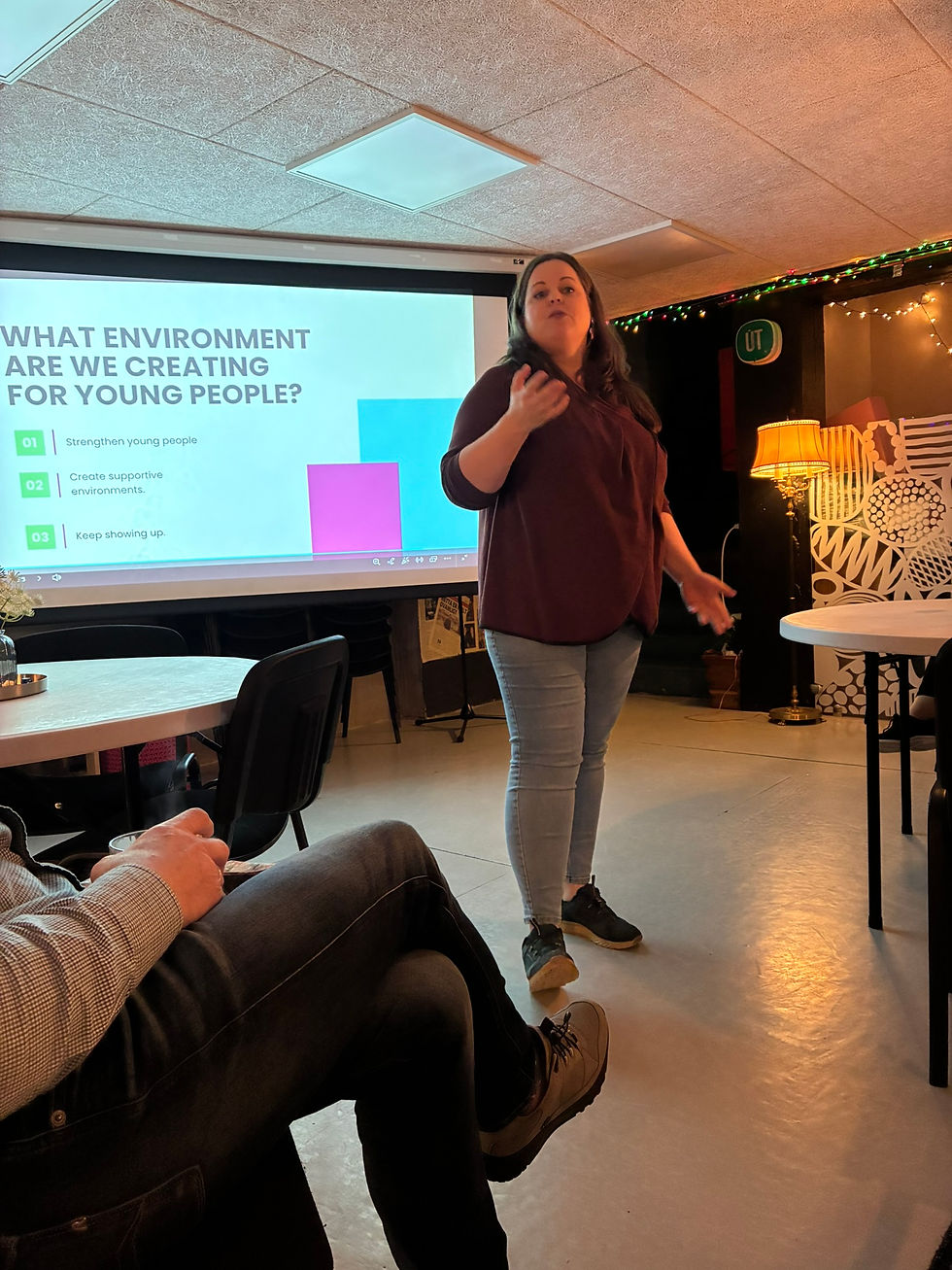
Lív Brúsá presented Lív Lívið’s approach to strengthening young people and the environments around them. Its work helps young people develop life skills, connect with trusted adults and delay their first alcoholic drink. Parents are supported in setting clear boundaries and building strong relationships with their children. Prevention also reaches into community life, from schools and youth centres to festivals and cultural events, creating opportunities for participation without alcohol. Her closing message was straightforward: strengthen young people, create supportive environments and keep showing up.
Maria Svabo Samuelsen described DAT Ung’s outpatient treatment for young people aged 15–25. Anyone can contact the service without a doctor’s referral. Assessment considers substance use alongside family relationships, school, work, housing and possible mental health conditions. Treatment plans are developed with the young person, and parents or guardians are regularly involved when the person is under 18. The work includes developing skills to manage emotions and everyday challenges, with greater cooperation between services when needs are more complex.
Together, the presentations showed how prevention and treatment can connect around young people and their families. Support may begin before a young person uses substances, through help with difficulties at home or opportunities in the community. When problems develop, early and accessible help can address both substance use and the circumstances surrounding it.
What have we learned, and where does alcohol policy go next?
The “In conversation” session brought together decades of experience in alcohol policy, research and advocacy. A recurring message was that evidence needs people and organisations who can explain it, build support and act when political opportunities arise. The discussion also challenged a sense of inevitability about commercial influence: recognising the strength of industry should help advocates develop their strategy, rather than leave them convinced that progress is impossible.
Nordic alcohol monopolies illustrated the challenge of defending established protections. People can support the monopoly while also favouring wine sales in grocery shops or direct sales from producers, without recognising how these changes may weaken the wider system. The panel discussed the need to explain more clearly what the public stands to lose. Monopolies can also offer small producers access to a market where large supermarket chains would demand volumes or commercial terms they cannot meet. These practical arguments can reach audiences beyond those already committed to public health.
Public support should not be underestimated. The discussion drew on experience from Scotland, where minimum unit pricing became an accepted part of everyday life after its introduction. Policies that appear politically difficult can gain acceptance when people understand their purpose and see how they work. This requires sustained contact with politicians, clear communication and an understanding of audiences whose starting knowledge may be limited, but whose capacity to understand should not be dismissed.
Civil society’s strength also lies in sharing knowledge and working across borders. NordAN’s resolutions, country information and policy material can have greater reach when members translate and circulate them through their own networks. Cooperation with researchers, public officials and organisations working on tobacco, nutrition and other areas of prevention can strengthen the case for population-level measures. The panel also acknowledged difficult choices about participation in policy forums: remaining involved can offer influence, but participation must be judged against whether it produces meaningful results.
The closing messages urged the region to keep learning and avoid complacency. Nordic experience remains valuable, while developments in the Baltic countries and the Faroe Islands provide lessons of their own. Better data, practical tools for identifying alcohol problems and continued public education all have a role. Declining consumption does not remove the need for prevention, support for vulnerable groups or attention to changing patterns of drug and nicotine use among young people.
Faroe Islands resolutions
1. More comparable alcohol data in the Nordic and Baltic countries
Reliable data is essential for understanding alcohol consumption, alcohol-related harm and the effects of policy. Yet comparisons between Nordic and Baltic countries remain difficult because definitions, sources and calculation methods differ. Figures on consumption, deaths and hospitalisations may therefore reflect differences in how countries collect information, rather than real differences in harm.
NordAN calls on governments, statistical authorities and public health institutions to publish alcohol data regularly, explain their methods clearly and strengthen cooperation across borders. More consistent indicators would help countries evaluate policies, identify trends and learn from one another. They would also give researchers, policymakers and the public a clearer picture of alcohol-related problems across the region.
2. Protecting young people through strong alcohol age limits
Age limits help protect children and young people from early alcohol use and environments where drinking is central. The resolution responds to proposals to lower purchase ages or allow younger people to sell and serve alcohol. While such changes may be presented as opportunities for employment or greater independence, NordAN stresses that young people’s health and safety must remain the priority.
NordAN calls for maintaining strong minimum purchase ages and increasing them where existing limits are low. It also urges protection for young workers in alcohol-related settings, effective age verification and enforcement, and reduced distance sales and home delivery. Decisions should reflect evidence about alcohol’s effects on young people’s health and development. Safe opportunities for work and participation can support independence without weakening established protections.
Back in the Faroe Islands, 21 years later


NordAN’s 2005 conference took place on 7–8 October, bringing together discussions on Faroese alcohol and drug policy, youth prevention, Nordic cooperation and developments in the EU and WHO. The programme explored the history and importance of the Faroese alcohol monopoly, Finland’s monopoly within the EU, and the role of civil society in prevention. Participants also visited the Nordic House and joined an excursion to Tórshavn and Kirkjubøur. Twenty-one years later, these photographs recall an earlier gathering whose central questions remain familiar: how to protect effective alcohol policies, strengthen prevention and learn from one another across borders.

Tórshavn +6: a planned online follow-up
Looking towards April 2027
Around six months after the Faroe Islands conference, we are considering an online meeting to revisit the main discussions, share developments from across the Nordic and Baltic region, and see how ideas from Tórshavn have translated into action. This would be a midway stop on our journey to the next NordAN conference in Lithuania, keeping the conversation alive and helping shape the questions we take forward. The date and programme are still to be confirmed.