

Alcohol problems among working-age Helsinki residents are most common in older age groups
06.10.2026 - A new study finds that more than one in four employed Helsinki residents drink alcohol at risky levels, while almost one in ten engage in heavy episodic drinking. Alcohol problems have declined considerably among younger employees over the past decade, but the change has been much smaller among people aged 50–64. Among women, risky alcohol use is also associated with reduced work ability.
Problematic substance use affects not only individual health and the ability to cope at work, but can also affect workplaces and employers. The new study examined substance use among employed Helsinki residents and the relationship between problematic use and self-assessed work ability.
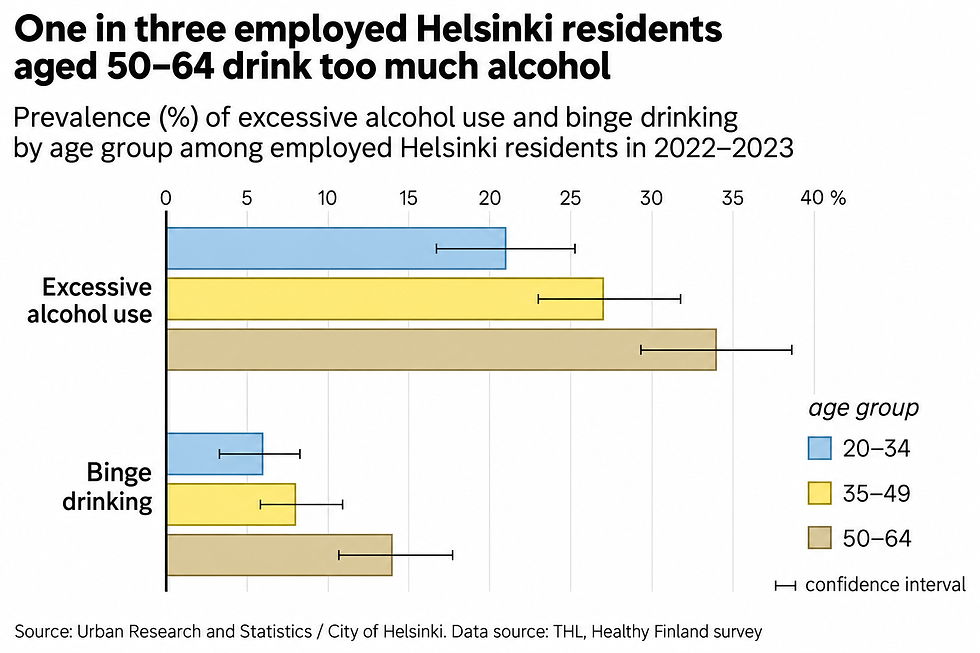
Among employed men in Helsinki, one in three drinks alcohol at risky levels, compared with more than one in five women. Heavy episodic drinking was reported by 14% of men and 5% of women.
Differences between age groups were clear. More than one in three employed people aged 50–64 drink at risky levels, and 14% engage in heavy episodic drinking. The corresponding proportions are lower among younger employees.
The age differences are particularly pronounced among men. Among men in the oldest age group, risky alcohol use is twice as common and heavy episodic drinking almost three times as common as among men aged 20–34.
Over a period of just under ten years, risky alcohol use among employed Helsinki residents has fallen by around one third, while heavy episodic drinking has declined by 40%. In the youngest age group, problematic alcohol use has fallen by more than 50%.
Among people aged 50–64, however, the decline has been much smaller. Risky alcohol use has decreased by only a little over 10%, while heavy episodic drinking has fallen by 7%.
Among employed men, 7% consider themselves partially or fully unable to work, compared with one in ten women. In addition, 14% of men and 17% of women believe they are unlikely to be able to continue working until the statutory retirement age.
Women who drink alcohol at risky levels are almost twice as likely as other women to consider themselves unable to work. The likelihood is even higher among women who engage in heavy episodic drinking. No corresponding statistically significant association was found among men in this study.
Eight percent of employed respondents had used cannabis during the previous year. Women who had used cannabis were more likely than other women to believe that they would probably not be able to continue working until retirement age.
The findings underline the importance of supporting work ability particularly among ageing employees. As people age, tolerance of alcohol decreases and recovery from its effects becomes slower. Early support, clear workplace procedures and cooperation with occupational health services can help protect work ability, safety and a stable working environment.
The study is based on Helsinki responses to the Healthy Finland population survey conducted by the Finnish Institute for Health and Welfare in 2022–2023. A total of 3,575 responses were received, with a response rate of 46.4%. The analyses included people aged 20–64 who were participating in working life.
Source: City of Helsinki. The study is based on the Finnish Institute for Health and Welfare’s Healthy Finland survey, 2022–2023.

